
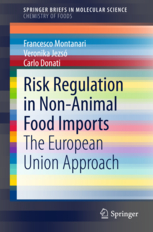
My dear friend Francesco Montanari recently published this excellent book – co-authored with Veronika Jezso and Carlo Donati – which highlights one of the less explored areas of food law: the import of food of non-animal origin. Despite these products are traditionally considered less dangerous than food of animal origin, recent food crisis showed that this stereotype is set to change. Moreover, this subject has a major impact on market access and, more generally, on trade flows in a globalized and theoretically liberalized market.
Risk Regulation in Non-Animal Food Imports, Montanari F., Jezso V., Donati. C., Springer Brief February 2015. Here you can download the table of contents.
This latest Springer Brief aims at providing a general understanding of the rationale – scientific as well as political – behind EU policy and related risk management decisions regarding imports of food of non-animal origin. Indeed, over the last years, threats deriving from imported food of non-animal origin seem to have multiplied, including sprout seeds contaminated with E. coli and strawberries containing hepatitis A or noroviruses.
Against this background, the authors explain the mechanism of reinforced controls at EU borders on certain imports of non-animal origin as well as the wide spectrum of EU emergency measures currently imposing trade restrictions on some of those products considered as presenting a high risk for public health. They also examine all chemical and non-chemical risks that may be associated with imports of non-animal origin and their impact on human health, taking into account the scientific output by the European Food Safety Authority.
Discover more from FOOD LAW LATEST
Subscribe to get the latest posts sent to your email.
