

This is good news for nutrition-savvy Canadian consumers.
As of January 1, 2026, all prepacked food products entering the Canadian market should comply with the new front-of-pack nutrition labeling rules, bearing a logo similar to the following one anytime they are considered high in saturated fats, sugars, and/or sodium:
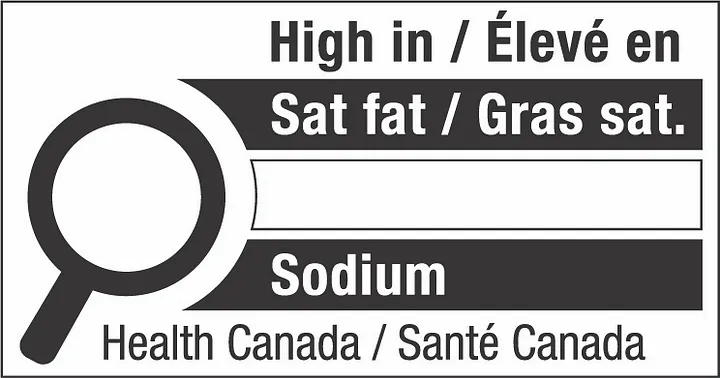
The logo should be displayed on the principal display panel, which is the side of the label that consumers will see at the moment of purchase, with specific size and positioning requirements to ensure visibility.
Even if it is well known that such schemes alone are not able to solve obesity challenges and orient consumers’ behaviours, the choice of a big logo with a black color can be considered a strong policy option. The black color per se triggers in our brain a defensive reaction, and it contrasts well with the vivid graphics of most food products.
But let’s better unpack such requirements.
On July 20, 2022, Health Canada published the Regulations Amending the Food and Drug Regulations (Nutrition Symbols, Other Labelling Provisions, Vitamin D and Hydrogenated Fats or Oils) in the Canada Gazette, Part II (CGII). These regulations amended the Food and Drug Regulations (FDR) to add the new requirement for front-of-package (FOP) nutrition symbol labelling (FOP labelling) for most prepackaged food products containing nutrients of public health concern (saturated fat, sugars, and/or sodium) at or above specified thresholds.
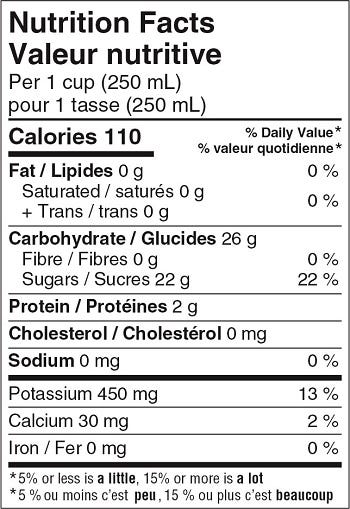
The thresholds to trigger the application of the FOP logos are based on the Daily Values (DVs) established by the Canadian Food Inspection Agency (CFIA). The Daily Values are the percentages that you can find in the Nutrition Factstable, on the right side, on most of the items you buy at grocery stores. Check this template for clarity:
For most prepackaged products, a symbol must appear on the label when the amount of saturated fat, sugars, and/or sodium is ≥ (equal to or greater than) 15% of the applicable DV, with a few exceptions listed below:
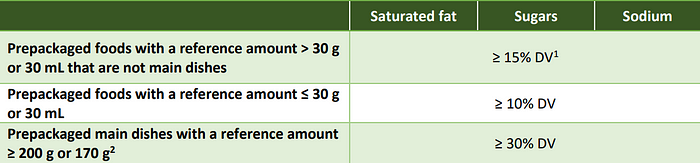
The quantity of food on which you have to base the calculation is either the serving size stated in the Nutrition Facts panel or the reference amount for the product established by the CFIA, whichever quantity is greater.
Some foods will get a full exemption from the requirements, mostly because they are either obviously high in such nutrients or are not intended to be sold prepacked to consumers. Some examples:
- Shipping containers, if the container and its contents are not sold as a single unit to a consumer at retail
- Products with an available display surface < (less than) 15 cm2
- Individual portions of food that are intended solely to be served by a restaurant or other commercial enterprise with meals or snacks
- Ready-to-serve multiple-serving products intended only to be served in a commercial or industrial enterprise or an institution
- Products intended only to be used as ingredients in other prepackaged products intended to be sold to consumers at retail or as ingredients in the preparation of food by a commercial or industrial enterprise or an institution
- Whole, partly skimmed, and skimmed cow or goat’s milk sold in refillable glass containers, flavoured whole, partly skimmed, and skimmed cow’s milk sold in refillable containers, as well as cream sold in refillable glass containers
- Sweetening agents, when sold as such. Examples: sugar; agave syrup; corn syrup; maple syrup, table syrup; honey; and molasses
- Salt and seasoning salt that includes “salt” in its common name and sold as such
- Fats and oils, fish and other marine fats and oils, butter, ghee, margarine and other similar substitutes for butter and sold as such
- Individual rations intended for use by military personnel engaged in operations or exercises
Then we have “conditional exemptions”, mostly for foods that naturally contain such nutrients but are deemed to be nutritionally a net positive for the general population, such as:
- Whole or cut fresh, frozen, canned, or dried fruits or vegetables o
- Milk from any animal, in liquid or powdered form (not the plant-based alternatives)
- Whole eggs, fresh or in liquid, frozen, or dried form, or whole egg mixes
- Nuts, seeds, or their butters that contain less than 30% of their total fat content as saturated fat
- Vegetable or marine oils that contain less than 30% of their total fat content as saturated fat
- Marine or freshwater animal products that contain less than 30% of their total fat content as saturated fat.
In the end, some products, subject to specific regulations, will be prohibited to bear such FOP logos at all, namely:
- Products intended solely for infants six months of age or older but less than one year of age
- Human milk fortifiers
- Human milk substitutes (infant formula)
- Foods represented as containing a human milk substitute
- Formulated liquid diets
- Meal replacements
- Nutritional supplements
- Foods represented for protein-restricted diets
- Foods represented for low (naming the amino acid) diets
- Foods represented for use in a very low energy diet
This is because their composition is provided by the law, and they satisfy very specific dietary needs.
You can find the full guidance on the topic at the following link, but with the info I provided, you are ready to shop and at least get a sense of what you will find on the label!
Discover more from FOOD LAW LATEST
Subscribe to get the latest posts sent to your email.
