
The request for a preliminary ruling, referred by the Czech Supreme Administrative Court, concerns the interpretation of Articles 34 and 36 TFEU, on the free movement of goods, and Article 9(7) of Regulation (EU) 2017/625, on official controls in the agri-food chain.
The reference arises from a dispute between the Czech company PRAGON s.r.o. and the national agri-food control authority (Prague Inspectorate), concerning the lawfulness of an inspection carried out on the basis of Czech 𝐥𝐞𝐠𝐢𝐬𝐥𝐚𝐭𝐢𝐨𝐧 𝐫𝐞𝐪𝐮𝐢𝐫𝐢𝐧𝐠 𝐫𝐞𝐜𝐢𝐩𝐢𝐞𝐧𝐭𝐬 𝐨𝐟 𝐟𝐨𝐨𝐝 𝐬𝐮𝐩𝐩𝐥𝐞𝐦𝐞𝐧𝐭𝐬 𝐟𝐫𝐨𝐦 𝐨𝐭𝐡𝐞𝐫 𝐌𝐞𝐦𝐛𝐞𝐫 𝐒𝐭𝐚𝐭𝐞𝐬 𝐭𝐨 𝐧𝐨𝐭𝐢𝐟𝐲 𝐭𝐡𝐞 𝐚𝐫𝐫𝐢𝐯𝐚𝐥 𝐨𝐟 𝐭𝐡𝐞 𝐠𝐨𝐨𝐝𝐬 𝐚𝐭 𝐥𝐞𝐚𝐬𝐭 𝟐𝟒 𝐡𝐨𝐮𝐫𝐬 𝐢𝐧 𝐚𝐝𝐯𝐚𝐧𝐜𝐞, providing information relevant for risk analysis and the planning of controls.
The Court first clarifies that Article 9(7) of Regulation 2017/625 has brought about exhaustive harmonisation of the matter, with the result that the national legislation must be assessed exclusively in the light of that Regulation and not under Articles 34 and 36 TFEU. On the substance, the Court holds that a notification obligation may be imposed only in exceptional circumstances and within the limits of what is strictly necessary for the organisation of controls, namely where there are no less restrictive alternative measures. That restrictive interpretation is also justified by the fact that the provision constitutes a derogation from the principle of equal treatment of goods laid down in Article 9(6) of the same Regulation. Moreover, Member States already have appropriate instruments to ensure the effectiveness of controls, such as administrative assistance mechanisms, national control plans, and lists of operators.
The Court (Third Chamber) therefore rules that 𝐀𝐫𝐭𝐢𝐜𝐥𝐞 𝟗(𝟕) 𝐨𝐟 𝐑𝐞𝐠𝐮𝐥𝐚𝐭𝐢𝐨𝐧 𝟐𝟎𝟏𝟕/𝟔𝟐𝟓 𝐩𝐫𝐞𝐜𝐥𝐮𝐝𝐞𝐬 𝐧𝐚𝐭𝐢𝐨𝐧𝐚𝐥 𝐥𝐞𝐠𝐢𝐬𝐥𝐚𝐭𝐢𝐨𝐧 𝐰𝐡𝐢𝐜𝐡 𝐢𝐦𝐩𝐨𝐬𝐞𝐬 𝐨𝐧 𝐚𝐧𝐲 𝐨𝐩𝐞𝐫𝐚𝐭𝐨𝐫 𝐫𝐞𝐜𝐞𝐢𝐯𝐢𝐧𝐠 𝐟𝐨𝐨𝐝 𝐬𝐮𝐩𝐩𝐥𝐞𝐦𝐞𝐧𝐭𝐬 𝐟𝐫𝐨𝐦 𝐚𝐧𝐨𝐭𝐡𝐞𝐫 𝐌𝐞𝐦𝐛𝐞𝐫 𝐒𝐭𝐚𝐭𝐞 𝐚 𝐠𝐞𝐧𝐞𝐫𝐚𝐥 𝐨𝐛𝐥𝐢𝐠𝐚𝐭𝐢𝐨𝐧 𝐭𝐨 𝐧𝐨𝐭𝐢𝐟𝐲 𝐢𝐧 𝐚𝐝𝐯𝐚𝐧𝐜𝐞 𝐭𝐡𝐞 𝐚𝐫𝐫𝐢𝐯𝐚𝐥 𝐨𝐟 𝐭𝐡𝐞 𝐠𝐨𝐨𝐝𝐬 and to provide the information necessary for risk analysis and the planning of official controls.
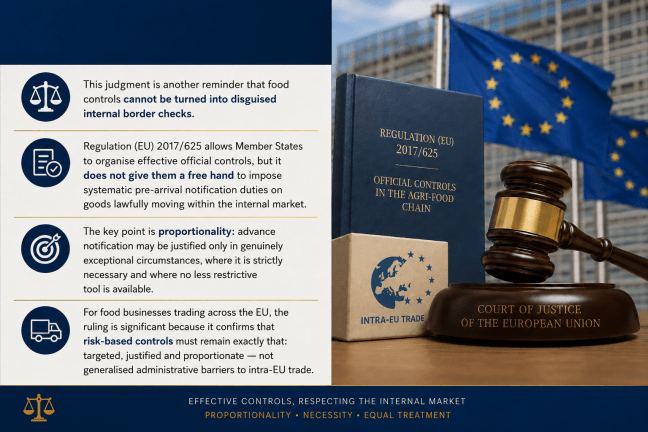
This judgment is another reminder that food controls cannot be turned into disguised internal border checks or technical barriers to the free circulation of goods within the EU.
Regulation (EU) 2017/625 allows Member States to organise effective official controls, but it does not give them a free hand to impose systematic pre-arrival notification duties on goods lawfully moving within the internal market.
The key point is proportionality: advance notification may be justified only in genuinely exceptional circumstances, where it is strictly necessary and where no less restrictive tool is available. It has to be remembered, then, that in most EU countries, food supplements are also notified to the local competent authorities before being marketed.
For food businesses trading across the EU, the ruling is significant because it confirms that risk-based controls must remain exactly that: targeted, justified and proportionate — not generalised administrative barriers to intra-EU trade. On top of that, it demonstrates a clear trend by the EU Commission and Court of Justice in protecting, more than in the past, the free circulation of goods in the common market.
Discover more from FOOD LAW LATEST
Subscribe to get the latest posts sent to your email.

One thought on “𝐄𝐔 𝐂𝐨𝐮𝐫𝐭 𝐨𝐟 𝐉𝐮𝐬𝐭𝐢𝐜𝐞 𝐩𝐫𝐨𝐭𝐞𝐜𝐭𝐢𝐧𝐠 𝐭𝐡𝐞 𝐟𝐫𝐞𝐞 𝐦𝐨𝐯𝐞𝐦𝐞𝐧𝐭 𝐨𝐟 𝐟𝐨𝐨𝐝 𝐬𝐮𝐩𝐩𝐥𝐞𝐦𝐞𝐧𝐭”