
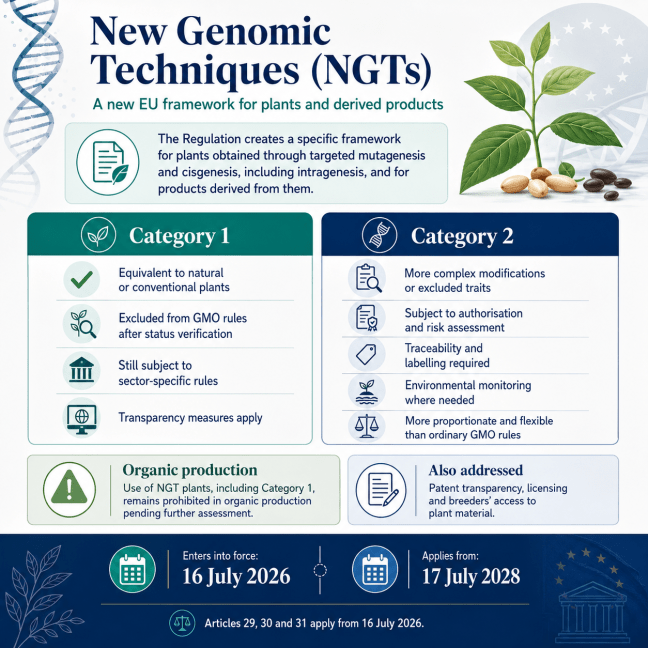
The Regulation (EU) 2026/1388 introduces a specific legal framework for plants obtained through certain new genomic techniques (NGTs), in particular targeted mutagenesis and cisgenesis, including intragenesis, as well as for products derived from those plants.
The measure responds to the 𝐧𝐞𝐞𝐝 𝐭𝐨 𝐦𝐨𝐯𝐞 𝐛𝐞𝐲𝐨𝐧𝐝 𝐭𝐡𝐞 𝐢𝐧𝐝𝐢𝐬𝐜𝐫𝐢𝐦𝐢𝐧𝐚𝐭𝐞 𝐚𝐩𝐩𝐥𝐢𝐜𝐚𝐭𝐢𝐨𝐧 𝐨𝐟 𝐭𝐫𝐚𝐝𝐢𝐭𝐢𝐨𝐧𝐚𝐥 𝐆𝐌𝐎 𝐥𝐞𝐠𝐢𝐬𝐥𝐚𝐭𝐢𝐨𝐧 to techniques which, in some cases, may produce modifications that are 𝐢𝐧𝐝𝐢𝐬𝐭𝐢𝐧𝐠𝐮𝐢𝐬𝐡𝐚𝐛𝐥𝐞 𝐟𝐫𝐨𝐦 𝐭𝐡𝐨𝐬𝐞 𝐨𝐜𝐜𝐮𝐫𝐫𝐢𝐧𝐠 𝐧𝐚𝐭𝐮𝐫𝐚𝐥𝐥𝐲 𝐨𝐫 𝐨𝐛𝐭𝐚𝐢𝐧𝐚𝐛𝐥𝐞 𝐭𝐡𝐫𝐨𝐮𝐠𝐡 𝐜𝐨𝐧𝐯𝐞𝐧𝐭𝐢𝐨𝐧𝐚𝐥 𝐛𝐫𝐞𝐞𝐝𝐢𝐧𝐠.
The Regulation establishes two categories of NGT plants.
➡️ 𝐂𝐚𝐭𝐞𝐠𝐨𝐫𝐲 𝟏 𝐍𝐆𝐓 𝐩𝐥𝐚𝐧𝐭𝐬 are considered equivalent to plants occurring in nature or obtained through conventional techniques. They are excluded from the GMO framework, subject to prior verification of their status and the issuance of a declaration.
However, they remain subject to the applicable sector-specific rules on seeds, food, feed and other products. Transparency measures are also foreseen, including a public database, identification of the plant, and an indication that the plant reproductive material is Category 1 NGT material.
➡️ 𝐂𝐚𝐭𝐞𝐠𝐨𝐫𝐲 𝟐 𝐍𝐆𝐓 𝐩𝐥𝐚𝐧𝐭𝐬, by contrast, cover plants with more complex modifications or traits excluded from Category 1, such as herbicide tolerance or the production of known insecticidal substances.
These plants remain subject to authorisation, risk assessment, traceability, labelling and, where necessary, environmental monitoring. At the same time, the Regulation introduces more proportionate and flexible procedures than the ordinary GMO framework, including possible incentives for sustainability-oriented traits and further facilitation for SMEs.
⛔ The relationship with organic production is also particularly relevant. 𝐓𝐡𝐞 𝐮𝐬𝐞 𝐨𝐟 𝐍𝐆𝐓 𝐩𝐥𝐚𝐧𝐭𝐬, 𝐢𝐧𝐜𝐥𝐮𝐝𝐢𝐧𝐠 𝐂𝐚𝐭𝐞𝐠𝐨𝐫𝐲 𝟏 𝐍𝐆𝐓 𝐩𝐥𝐚𝐧𝐭𝐬, 𝐫𝐞𝐦𝐚𝐢𝐧𝐬 𝐩𝐫𝐨𝐡𝐢𝐛𝐢𝐭𝐞𝐝 𝐢𝐧 𝐨𝐫𝐠𝐚𝐧𝐢𝐜 𝐩𝐫𝐨𝐝𝐮𝐜𝐭𝐢𝐨𝐧, pending further assessment.
The Regulation also addresses patent transparency, licensing and breeders’ access to plant material.
The Regulation 𝐞𝐧𝐭𝐞𝐫𝐬 𝐢𝐧𝐭𝐨 𝐟𝐨𝐫𝐜𝐞 𝐨𝐧 𝟏𝟔 𝐉𝐮𝐥𝐲 𝟐𝟎𝟐𝟔 𝐚𝐧𝐝 𝐚𝐩𝐩𝐥𝐢𝐞𝐬 𝐟𝐫𝐨𝐦 𝟏𝟕 𝐉𝐮𝐥𝐲 𝟐𝟎𝟐𝟖, with the exception of Articles 29, 30 and 31, which apply from 16 July 2026.
Source: https://eur-lex.europa.eu/legal-content/EN/TXT/PDF/?uri=OJ:L_202601388
Discover more from FOOD LAW LATEST
Subscribe to get the latest posts sent to your email.
