

The EU just introduced monitoring of 𝐜𝐡𝐥𝐨𝐫𝐢𝐧𝐚𝐭𝐞𝐝 𝐩𝐚𝐫𝐚𝐟𝐟𝐢𝐧𝐬 in food under Recommendation (EU) 2026/2335.
Member States should cooperate with food businesses to collect data 𝐟𝐫𝐨𝐦 𝟐𝟎𝟐𝟔 𝐭𝐨 𝟐𝟎𝟐𝟗. The initiative follows EFSA’s identification of substantial gaps preventing a robust dietary exposure assessment.
Monitoring covers fish, dairy products, oils and fats, other animal products, processed foods (whole meal) and infant foods.
The approach has two tiers. The sum of C10–C17 PCAs, the predominant group in food, should be determined using GC-MS/MS or GC-LRMS, which are more widely available and less costly techniques; alternative methods are acceptable provided their equivalence has been demonstrated. If the sum exceeds the threshold values, the sample should be analysed for all PCAs, including C18–C30, using LC or GC coupled with high-resolution mass spectrometry (HRMS).
The threshold values for the sum of C10–C17 PCAs are:
🐟 Fish: 100 ng/g fresh weight;
🥛 Milk and dairy products: 20 ng/g fresh weight;
🧈 Vegetable and animal oils and fats: 1,000 ng/g fat;
🥩 Other products of animal origin (e.g., meat and eggs): 300 ng/g fat;
🍲 Processed foods: 50 ng/g fresh weight;
🍼 Foods for infants and young children: 20 ng/g fresh weight.
These are 𝐭𝐡𝐫𝐞𝐬𝐡𝐨𝐥𝐝𝐬 𝐬𝐞𝐭 𝐟𝐨𝐫 𝐝𝐚𝐭𝐚 𝐠𝐚𝐭𝐡𝐞𝐫𝐢𝐧𝐠 𝐚𝐧𝐝 𝐚𝐝𝐝𝐢𝐭𝐢𝐨𝐧𝐚𝐥 𝐢𝐧𝐯𝐞𝐬𝐭𝐢𝐠𝐚𝐭𝐢𝐨𝐧, 𝐧𝐨𝐭 𝐦𝐚𝐱𝐢𝐦𝐮𝐦 𝐩𝐞𝐫𝐦𝐢𝐭𝐭𝐞𝐝 𝐜𝐨𝐧𝐭𝐚𝐦𝐢𝐧𝐚𝐧𝐭 𝐥𝐞𝐯𝐞𝐥𝐬 𝐭𝐫𝐢𝐠𝐠𝐞𝐫𝐢𝐧𝐠 𝐞𝐧𝐟𝐨𝐫𝐜𝐞𝐦𝐞𝐧𝐭, but for businesses, this is a timely warning of potential regulatory limits coming in the future.
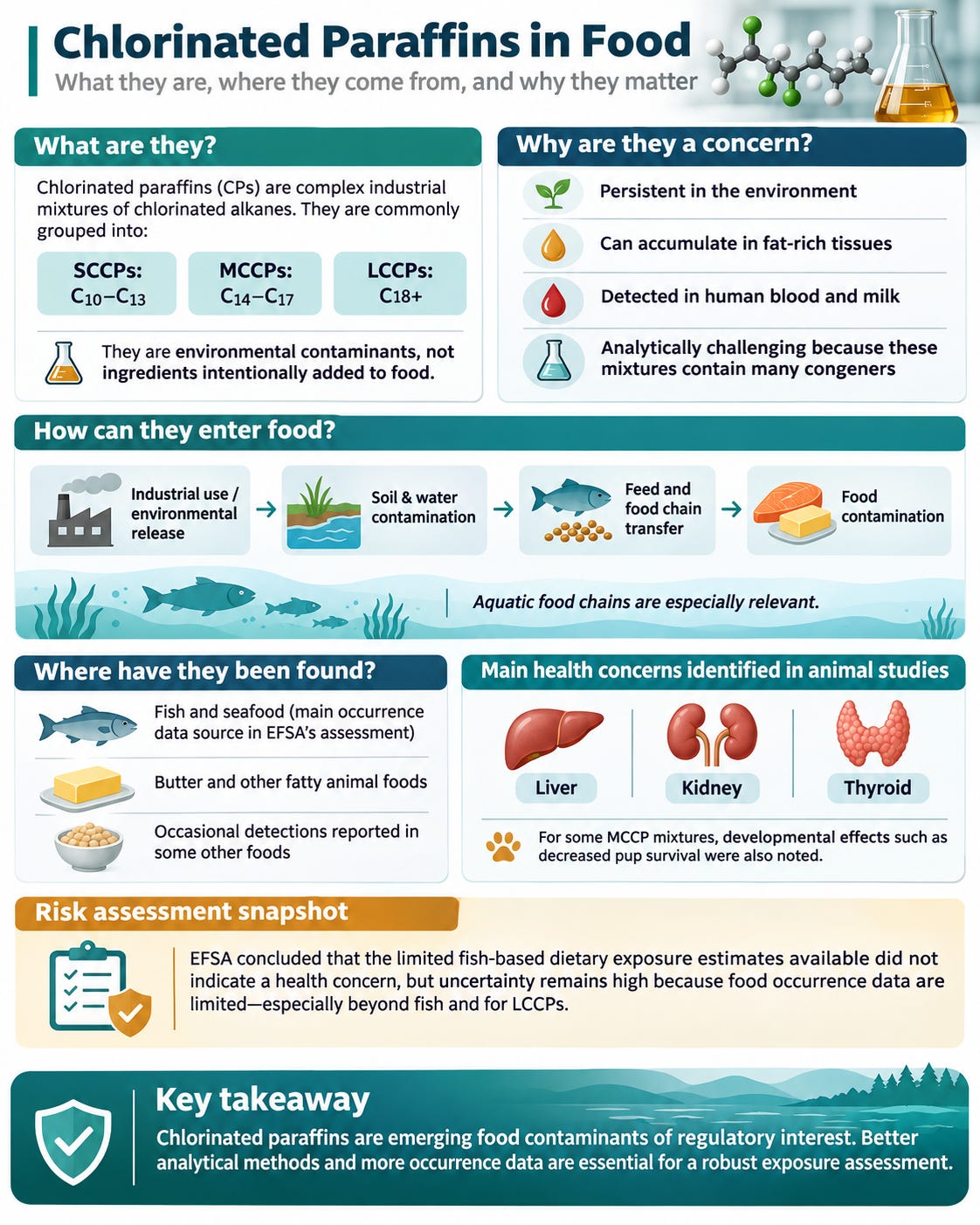
Chlorinated paraffins (CPs), also called polychlorinated alkanes, are mixtures of straight-chain hydrocarbons in which chlorine replaces some of the hydrogen. They have been used as plasticisers in PVC, as flame retardants, and in metalworking lubricants. Their relevance to food is long-term dietary exposure. Some break down slowly, accumulate in animal tissues, and reach consumers through the food chain.
Fish and shellfish can accumulate CPs from a contaminated environment. Equipment can also introduce them during preparation. In one study, researchers traced CPs released by certain hand blenders into an oil-and-water mixture back to bearings or plastic components. A separate food survey in southern Germany found the highest concentrations of short- and medium-chain CPs in fish and extra virgin olive oil.
Repeated exposure to certain short- and medium-chain mixtures affected the kidneys, liver and thyroid in laboratory animals. High doses of some short-chain mixtures also caused tumours in rodents. At the exposure levels estimated for European consumers, the picture is more reassuring.
EFSA’s 2020 assessment found low concern for short- and medium-chain CPs from fish consumption, although its data were too limited to assess the whole diet or establish a tolerable daily intake. In 2025, Germany’s BfR reviewed newer data and likewise judged typical European exposure to these two groups to be of low concern. The risk from long-chain CPs remains less well characterised.
Surely more scientific evidence will emerge in light of the activation of this monitoring plan.
Discover more from FOOD LAW LATEST
Subscribe to get the latest posts sent to your email.
