
Every two years, you have to remember a U.S. relevant deadline that is surprisingly easy to overlook.
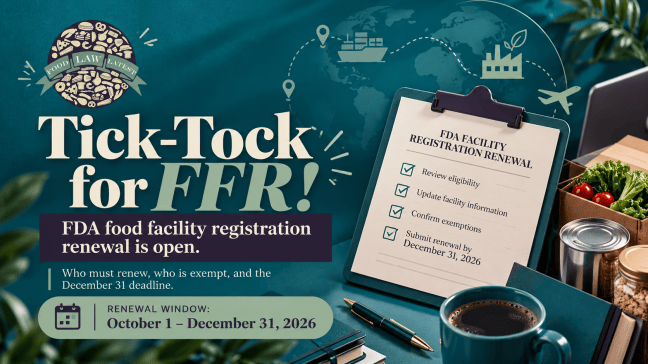
The U.S. Food and Drug Administration opened the 2026 biennial renewal period for Food Facility Registrations (FFR). Facilities subject to registration have from October 1 to December 31, 2026 to renew.
Section 415 of the Federal Food, Drug, and Cosmetic Act (FD&C Act) requires domestic and foreign facilities that manufacture, process, pack, or hold food for human or animal consumption in the United States to register with FDA, unless an exemption applies.
The first thing to remember is that this is a facility-based obligation, not a company-based one.
This means that selling food in the United States does not, by itself, mean that every company involved in the transaction needs an FDA food facility registration. What matters is what happens at the individual site or sites: if you have more than one site involved, indeed you have to register all of them and renew their FFR biannually.
For domestic facilities, the FFR may be required even where the food does not enter interstate commerce and stays local. Foreign facilities are instead covered in any case where food manufactured, processed, packed, or held there is intended for consumption in the United States. Foreign facilities must also designate or confirm a U.S. agent as their representative to deal with FDA and local authorities.
Under 21 CFR 1.226, exemptions from FFR include, among others, domestic farms, retail food establishments, restaurants, nonprofit food establishments and certain fishing vessels.
A foreign facility may also be exempt, but only where its food undergoes further manufacturing or processing at another foreign facility before being exported to the United States. The exemption does not work where the downstream facility performs only a de minimis activity, such as adding labeling or carrying out another similarly minor operation. A broker or trading company, for example, will not normally need a facility registration merely because it facilitates the sale of food.
Remember that updating a registration is not the same as renewing it. If a facility changed its registration data earlier in the year, that does not eliminate the need to complete the biennial renewal.
Renewal is generally made electronically through FDA Industry Systems, and there are no fees involved for either registration or renewal. The registration must also contain an FDA-accepted and valid Unique Facility Identifier (UFI). FDA currently recognizes the D-U-N-S number for this purpose, issued by Dun & Bradstreet.
The deadline is December 31, 2026. Miss it, and FDA may treat the registration as expired and cancel it. The failure to register or renew when required is also a prohibited act under the FD&C Act, and for foreign facilities, this can quickly become a commercial problem with immediate economic consequences: food offered for import from a facility that should be registered but is not may be refused or held at the U.S. port of entry.
So this is a good moment for exporters to check if the house is in good order: registration details, U.S. agent designation, UFI validity, and whether the 2026 renewal has actually been completed.
Originally published at https://cesarevarallo.substack.com on October 2, 2026.
Discover more from FOOD LAW LATEST
Subscribe to get the latest posts sent to your email.

[like] Rebecca Kaya reacted to your message: ________________________________
LikeLike