
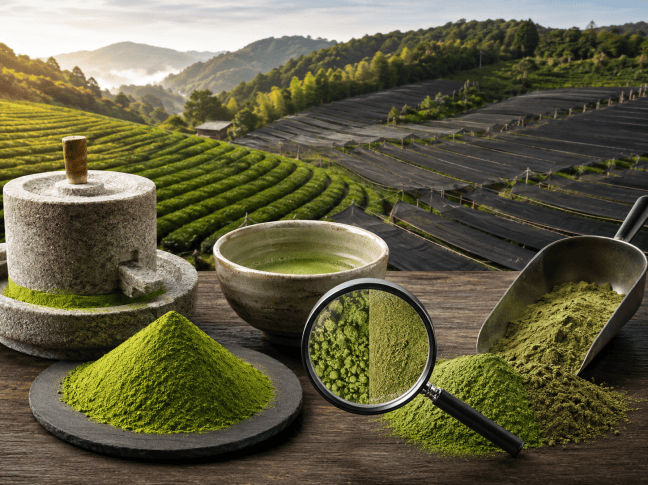
Japan’s green tea exports reached 13,125 tonnes in FY2025, up 42%, while their value more than doubled to ¥84.7 billion. Powdered green tea, including matcha, represented approximately 70% of the total.
This boom is transforming Japanese agriculture. Producers are progressively converting fields from sencha, Japan’s traditional infused green tea, to tencha, the shade-grown raw material used for matcha. Tencha production increased for four consecutive years through 2024, while sencha supply contracted and its price also began to rise.
The Japanese Government is supporting the transition by subsidising shading equipment and specialised processing machinery. Conversion, however, is neither immediate nor accessible to everyone: around 40% of Japanese tea plantations are located in hilly or mountainous areas, while the sector faces an ageing workforce and a lack of successors.
Price pressure is striking. Kyoto tencha averaged ¥13,972/kg in 2026, 69% more than the previous year. Indicative FOB prices for finished Japanese matcha now range from approximately US$35–80/kg for culinary grades to US$100–320/kg for products marketed as ceremonial grade.
Rapid demand, constrained supply, and widening price gaps create favourable conditions for economically motivated adulteration: substitution with cheaper green tea powder, undeclared blending, false Japanese or regional origin, and lower-grade or older material sold as premium matcha.
This is not evidence that fraud is already widespread. It is an early-warning signal. Italy, the USA, and many other significant markets are experiencing a steeply increasing demand.
Source: https://www.ilsole24ore.com/art/il-boom-globale-matcha-mette-crisi-te-tradizionale-giappone-AJVViqD
Discover more from FOOD LAW LATEST
Subscribe to get the latest posts sent to your email.
